ABOUT US
HISTORY OF CTC
The Congregation of Teresian Carmelites (CTC) is a religious institute founded by Venerable Servant of God Rev. Mother Eliswa in the Diocese of Verapoly.The Generalate of the congregation is located in Edapally, Kerala.
The History of CTC in brief is as follows:
The Congregation of Teresian Carmelites (CTC) is a religious institute founded by Venerable Mother Eliswa in the Diocese of Verapoly. Kerala. It is surprising to learn that until the second half of the19th century, there were no religious congregations for women and Catholic schools for girls in Kerala. Mother Eliswa was the precursor of women religious in Kerala and the Founderess of the first indigenous Third Order Discalced Carmelite Congregation (TOCD) for women in India which later bifurcated to the Congregation of Teresian Carmelites (CTC) and the Congregation of the Mother of Carmel (CMC).
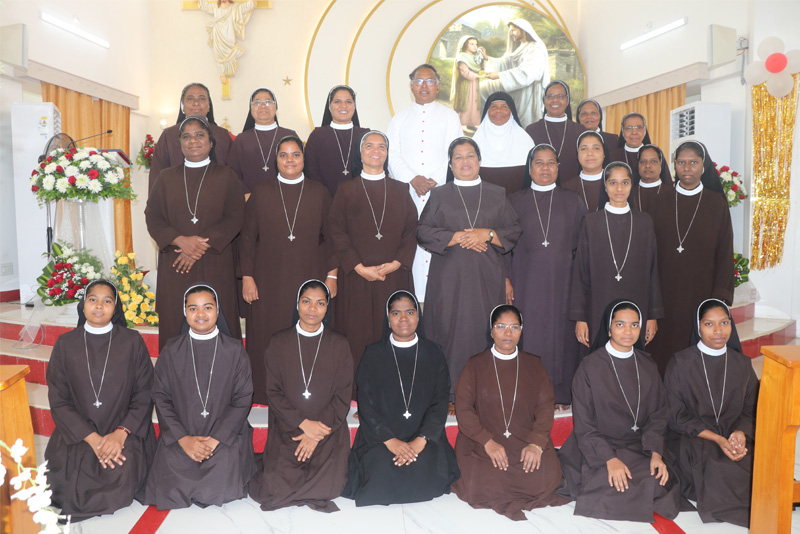
The TOCD Congregation for women founded by Venerable Mother Eliswa in 1866 at Koonammavu was the first religious Congregation in Kerala. Her own daughter Anna and her sister Thresia, were the Co-foundresses, who shared her charism. Mother Eliswa welcomed also the members of Syro-Malabar rite in the Congregation. After 24 years, the TOCD Congregation for women was divided into two based on the rites which the members follow. For the Latin members the Congregation of Teresian Carmelites (CTC) and for the Syrians The Congregation of the Mount Carment (CMC) were formed.
She established the first convent school, boarding house and orphanage for girls in Kerala and provided a value oriented and integral formation for girls and women. The members of both CMC and CTC, i.e. more than 7000 sisters, could receive the heavenly beams of prayer, sacrifice and service through Venerable Mother Eliswa Vakayil, the foundress. Mother Eliswa, the first religious sister, is the mother of all consecrated women in Kerala. Eliswa was born on 15th October, 1831 to a noble Vyppissery Capithan family in Cruz Milagris Parish at Ochanthuruth, in the Vicariate of Verapoly, Kerala. She was the first of eight children born to Thomman and Thanda. Louis, her third brother, was the first to be ordained a priest for the St Pius X Province of the Discalced Carmelite Order in India. He was also the founder of the first Catholic bi-monthly, ‘Sathyanadha kahalam’. Louis was a scholar, a linguist and one of the translators of the Bible into Malayalam. He has written more than ten books.
In 1847 when Eliswa was 16, she was married to Vatharu Vakayil at Koonammavu and bore a daughter, Anna. When Vatharu fell ill and died, Eliswa refused to remarry and chose a life of prayer, detachment and solitude, received the Sacraments frequently, and spent long years in silent preparation for a life inspired by the Holy Spirit. An Italian Carmelite Missionary, Fr Leopold Beccaro OCD recognized her charism. Eliswa’s daughter, Anna, also decided to live a consecrated Life. Thresia, Mother Eliswa’s youngest sister also met Fr Leopold and expressed her desire to consecrate her life to God.
The then Vicar Apostolic of Verapoly, Archbishop Bernardine Baccinelli, OCD, officially signed the decree of foundation of the Third Order of the Discalced Carmelite Congregation for women (TOCD). On 13th February, 1866, these three Latin-Rite women moved from their home to the newly built bamboo convent on their property. It was the first convent in Kerala and the history of the TOCD is unique in the history of the Catholic Church. Later, members of the Syro-Malabar Rite were also admitted to this Congregation by Mother Eliswa. On 27th March, 1867 the sisters moved from the bamboo convent to St Teresa’s Convent at Koonammavu that had just been built on the property owned by Mother Eliswa and her daughter Anna. On 24th March, 1890, the Sacred Congregation of Propaganda Fide decided to change the jurisdiction over St Teresa’s Convent at Koonammavu from the Archdiocese of Verapoly to the newly established Vicariate of Thrissur for Syro-Malabar rite. On 17th September, 1890 all the Latin sisters, including the Foundress Mother Eliswa, had to leave the convent. They were sheltered in St. Teresa’s Convent (CSST) Ernakulam for few days after which they were brought to Varapuzha by the Archbishop of Verapoly. Today the two branches of this TOCD Congregation form two independent religious congregations: The Congregation of Teresian Carmelites (CTC) and the Congregation of the Mother of Carmel (CMC). Mother Eliswa received eternal reward on 18th July, 1913 and was buried in the special burial place in front of the St. Joseph’s and Mount Carmel Church at Varapuzha. After few years, the mortal remains were shifted to the tomb built in the convent compound. In 1997 her mortal remains were shifted again to the tomb inside the memorial building called Smruthi Mandhir in the Convent compound at Varapuzha.
Mother Eliswa was declared Servant of God on 6th March 2008 and was declared venerable on 8th Nov 2023.
The CTC congregation is dedicated to spreading the love and message of Jesus Christ through various ministries, including education, healthcare, and social services.
Educationist
Though the formal education was denied for girls at that time in Kerala, she taught the girls, language, Mathematics and handicrafts along with moral teachings, prayers, cooking and house management. This value-oriented formation brought an improvement in the status of women and it brought about a spiritual renewal in the families. She respected the poor and marginalized and convinced them of the dignity of human life and freedom of the children of God. Mother Eliswa empowered women training them in rosary making and other handicrafts, which still continues in the areas of Koonammavu and Varapuzha. She imparted integral education focusing on the physical, spiritual, moral, cultural and economic growth of women. She stood against social evils like caste system, untouchability and ignorance.
Relevance Today
Mother Eliswa presents a glorious model of consecrated life to this consumeristic and wounded world, which goes after pomp, luxuries and superficial pleasures. She believed that only the spirit of love, tolerance, mutual understanding and generosity of heart can heal the world. She was an embodiment of all these noble qualities. She is not only the foundress of religious congregation, but also of the first school for girls in Kerala, first boarding house and orphanages attached to the convent for poor and uncared children. She tried to dispel the darkness of illiteracy from the society by educating girls and empowering women.
Now the CTC has 213 convents in 11 Provinces and many houses in abroad too. The sisters dedicate themselves in the apostolate of prayer, education, moral formation of youth, running orphanages and old age homes, women welfare centres , Hospital ministry, family apostolate, social work, jail ministry, media and communication and other mission activities.